
By
Diyaa Mani
September 30, 2025
Updated
September 9, 2026
Mining is one of the most lucrative industries globally, offering high-paying roles for those willing to work in remote locations, harsh environments, and technically demanding conditions.
Whether you're considering a career shift or exploring mining jobs in resource-rich regions, understanding which roles offer the highest compensation can help you make informed decisions.
In this article, we’ll break down the top-paying job opportunities in mining, what qualifications they require, and how to position yourself for success in this dynamic field.

Why do mining jobs pay so well?
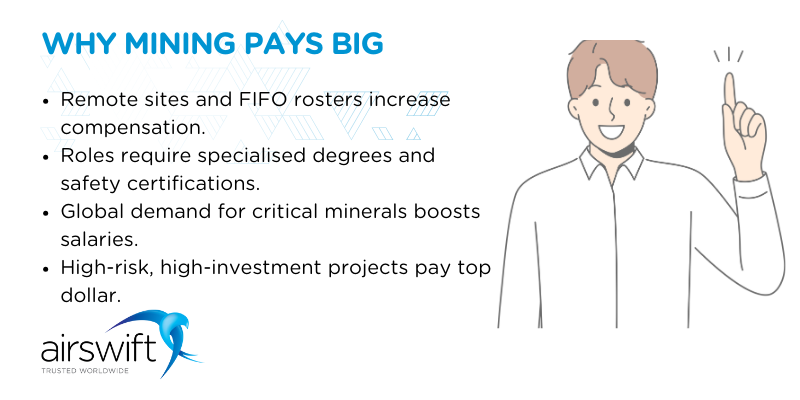
Mining is a high-stakes industry. The combination of physical risk, remote operations, and the need for specialised skills drives up salaries across the board. Here’s why:
- Remote and hazardous work: Many mining job sites are located in isolated areas, requiring fly-in-fly-out (FIFO) arrangements and long shifts.
- Specialised expertise: Roles often require engineering, geology, or environmental science degrees, plus certifications in safety and compliance.
- Global demand: Minerals like lithium, copper, and rare earth elements are critical to tech and energy sectors, increasing demand for skilled professionals.
- Capital-intensive projects: Mining operations involve billions in investment, and companies pay top dollar to ensure efficiency and safety.
Top 10 highest-paying jobs in mining
Here are the most lucrative mining jobs, along with salary ranges and career insights.
Project director / Mine manager
A project director or mine manager leads and coordinates all aspects of mining operations, including strategic planning, budgeting, safety compliance, and production targets. Acts as the key decision-maker across engineering, environmental, and workforce management functions to ensure operational efficiency and profitability.- Salary: $150,000 – $250,000/year
- Qualifications: Engineering degree, 10 to 15 years of industry experience, proven leadership capabilities and formal management training.
- Career path: Typically progresses from Senior Engineer to Operations Manager, gaining cross-functional exposure before advancing to Mine Manager, with potential to transition into executive roles such as Regional Director or VP of Operations.
Drilling operations manager
A drilling operations manager oversees drilling teams, equipment, and schedules to ensure safe, efficient, and cost-effective operations. Coordinates with geologists and engineers to align drilling activities with broader project goals and regulatory standards.- Salary: $150,000 – $220,000/year
- Qualifications: Degree in geotechnical or mechanical engineering; certified in drilling operations; 5+ years of field experience in supervisory roles.
- Career path: Begins as a Driller, progresses to Supervisor, and then advances to Operations Manager, with potential to move into senior project or regional leadership roles.
Geotechnical engineer
Someone in this role is responsible for evaluating ground conditions and designing excavation plans that ensure structural stability and safety. They also work closely with mining and civil teams to mitigate geotechnical risks and optimise site performance.
- Salary: $80,000 – $140,000/year
- Qualifications: Degree in civil or mining engineering with geotechnical specialisation or training.
- Career path: The career path starts as a Junior Engineer, develops into a Senior Engineer, and then becomes a Specialist, with opportunities to consult or lead geotechnical teams.
Metallurgist
A metallurgist develops and refines processes to extract and purify metals from ore. Key tasks include focusing on improving recovery rates, reducing waste, and enhancing cost-efficiency in mineral processing.- Salary: $80,000 – $140,000/year
- Qualifications: Degree in metallurgy or chemical engineering; hands-on experience in mineral processing environments.
- Career path: Begins as a Lab Technician, advances to Process Engineer, and then becomes a Metallurgist, with potential to specialise in research or plant optimisation.
Mining engineer
Mining engineers design mine layouts and plan extraction methods that maximise resource recovery while ensuring safety and regulatory compliance. They collaborate with geologists and operations teams to execute mining strategies.
- Salary: $90 - 160,000/year
- Qualifications: Degree in mining engineering; proficiency in mine planning software and modelling tools.
- Career path: Starts as a Graduate Engineer, progresses to Planning Engineer, and then becomes a Senior Engineer, with potential to move into project management or technical leadership.
Health and safety manager
Leads safety programmes and ensures compliance with health and safety regulations across mining operations. Conducts audits, delivers training, and fosters a safety-first culture.- Salary: $90,000 – $150,000/year
- Qualifications: Certified in occupational health and safety; experience in industrial or mining environments.
- Career path: Begins as a Safety Officer, advances to Coordinator, and then becomes Manager, with potential to move into corporate safety leadership or compliance roles.
Exploration geologist
Locates and evaluates mineral deposits through field surveys, sampling, and geological mapping. Collaborates with mining teams to guide exploration strategies and assess resource potential.- Salary: $85,000 – $150,000/year
- Qualifications: Degree in geology; proficiency in GIS and mapping tools; hands-on field experience in remote or challenging environments.
- Career path: Begins as a Field Geologist, progresses to Senior Geologist, and then advances to Exploration Lead, with potential to move into resource modelling or project development roles.
Heavy equipment operator (Specialised)
Operates large-scale machinery such as haul trucks, excavators, and loaders to support mining and construction activities. Ensures safe and precise handling of equipment in dynamic site conditions.- Salary: $70,000 – $130,000/year
- Qualifications: Certified in heavy equipment operation; on-site training; strong understanding of safety protocols and mechanical systems.
- Career path: Starts as an Operator, advances to Trainer, and then becomes Supervisor, with opportunities to specialise in fleet coordination or equipment management.
Blasting technician
Plans and executes controlled blasts to break rock for excavation, ensuring safety, precision, and compliance with regulations. Works closely with engineers and site managers to optimise blast outcomes.
- Salary: $50,000 – $100,000/year
- Qualifications: Licensed in blasting operations; trained in explosives handling and safety procedures.
- Career path: Begins as an Assistant, progresses to Technician, and then becomes Blasting Supervisor, with potential to move into planning or regulatory roles.
Environmental manager
Oversees environmental compliance and sustainability initiatives across mining operations. Monitors impact, manages reporting, and implements mitigation strategies to meet regulatory and corporate standards.- Salary: $90,000 – $130,000/year
- Qualifications: Degree in environmental science or engineering; certified in sustainability or environmental management systems.
- Career path: Starts as an Analyst, advances to Coordinator, and then becomes Manager, with potential to lead corporate ESG programmes or policy development.
What qualifications do you need for high-paying mining jobs?

To land a high-paying role in the mining industry, candidates typically need a mix of formal education, certifications, hands-on experience, and strong interpersonal skills.
Employers look for individuals who can combine technical expertise with practical field knowledge and leadership capabilities. The more specialised and safety-conscious your background, the more competitive you’ll be for top-tier roles.
- Degrees: Engineering (Mining, Civil, Mechanical), Geology, Metallurgy, Environmental Science.
- Certifications: Safety (MSHA, OSHA), Blasting, Equipment Operation.
- Experience: Fieldwork, internships, and project management are highly valued.
- Soft skills: Leadership, problem-solving, adaptability in remote environments.
Where are the highest-paying mining jobs located?
Mining salaries vary significantly by region, with certain countries offering premium compensation due to resource richness, remote site conditions, or labour demand.
If you're aiming for top pay, it's worth exploring opportunities in countries with mature mining sectors and high-value commodities. These regions often offer additional benefits like fly-in-fly-out (FIFO) arrangements, housing allowances, and performance bonuses.
- Australia: Known for high salaries and FIFO arrangements.
- Canada: Strong mining sector with opportunities in Ontario and British Columbia.
- Chile and Peru: Rich in copper and lithium, with a high demand for engineers.
- South Africa: Gold and platinum mining hubs.
- United States: Nevada, Arizona, and Alaska offer competitive roles.
How to get hired in a high-paying mining role
Breaking into a high-paying mining job requires strategic preparation and persistence. Whether you're just starting out or looking to move up, building a strong professional profile and staying connected to industry trends can make a big difference. Employers value candidates who show initiative, continuous learning, and a commitment to safety and operational excellence.
- Build a strong resume: Highlight certifications, field experience, and safety training.
- Network: Attend mining expos, join LinkedIn groups, and connect with recruiters.
- Upskill: Take short courses in GIS, AutoCAD, or mine planning software.
- Start small: Entry-level roles can lead to high-paying positions with experience.
Real salaries: What mining professionals are saying
Senior engineers in Australia can earn over $200,000 annually. Salary surveys show that experienced mining engineers and similar senior technical roles in Australia (especially in high-paying regions like Western Australia) command salaries around the USD $118,000–$130,000+ range.
GETI 2025 reports drilling supervisors earn up to USD $300,000 in the Australasian region, while geophysicists earn up to USD $169,307. Glassdoor likewise reports senior mining engineer salaries up to roughly USD $130,000 per year at the high end.
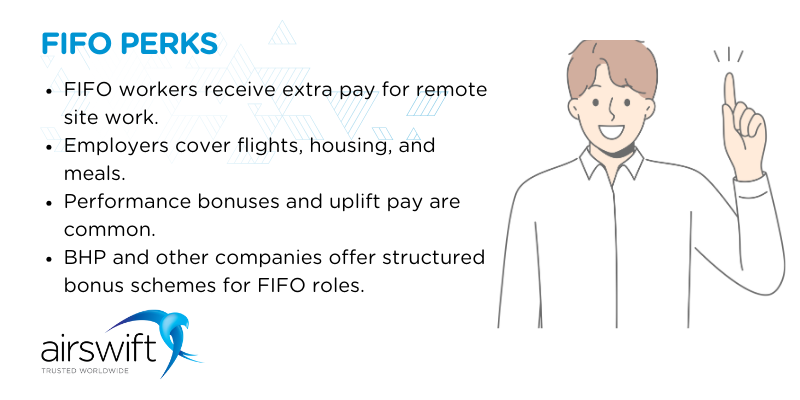
FIFO (Fly-In Fly-Out) workers receive significant extra allowances and bonuses. It’s common for FIFO mining jobs to include additional pay on top of base salary, such as remote area allowances (often tens of thousands of dollars yearly for working in isolated sites and paid travel.
Employers typically cover flights to/from the job site and provide housing and meals, which effectively boost total compensation. Many FIFO workers also earn performance bonuses or uplift pay for the demanding roster; for instance, BHP’s FIFO employees secured paid flights and bonus schemes as part of a recent agreement.
Health and safety managers in major mining regions like Australia commonly earn six-figure salaries (between AUD $140k and $200k for experienced professionals, especially in FIFO mining jobs). Moreover, surveys indicate that safety managers have high job satisfaction, rated about 4.1 out of 5 on average, meaning most find their work rewarding.
Explore mining careers with expert recruitment solutions
Mining jobs offer some of the best salaries across industries, especially for those with technical expertise and a willingness to work in challenging environments. Whether you are just starting out or looking to advance, investing in the right qualifications and experience can lead to a rewarding career.
At Airswift, we connect talented professionals globally with exciting opportunities in the mining industry. Our global recruitment network gives you access to top employers, transparent hiring processes, and expert guidance so you can confidently take the next step in your career.
Check out our global STEM job listings today and discover roles that match your skills, goals, and ambitions.