
By
Nathalia Duarte
July 6, 2026
Updated
July 6, 2026
Global contractor management in energy is no longer just about finding people and processing timesheets. It’s about safely mobilising specialists to complex onshore and offshore sites, staying compliant in multiple jurisdictions, and keeping projects on schedule from FEED to decommissioning.
Below is a practical list of the core contractor management services that effectively support both onshore and offshore operations across oil and gas, power, and renewables.

1. End‑to‑end contractor recruitment and workforce planning
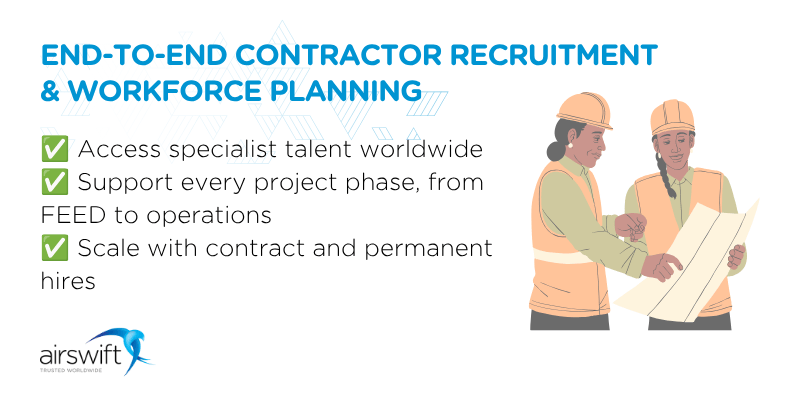
For energy companies, the starting point is access to the right technical contractors, when and where they’re needed. End‑to‑end recruitment services cover everything from market mapping to onboarding.
What are the key elements of a 360º contractor recruitment service?
- Building talent pipelines for critical disciplines (engineering, construction, QHSE, project controls, marine, offshore wind) across global hubs.
- Supporting full project lifecycles, from concept selection and FEED through hook‑up, commissioning, O&M, and life extension.
- Providing both contingent contractors and permanent hires so project teams can flex around demand.
The combination of reach and sector focus is what makes recruitment a true contractor management service, not just CV forwarding.
 2. Global contractor onboarding, payroll, and timesheet management
Once workers are selected, they must be onboarded, paid, and managed consistently across locations. Global contractor management services centralise this admin so local teams can focus on operations, not paperwork.
What admin tasks do global contractor management services cover?
- Standardised contracts and onboarding processes tailored to local labour law and industry requirements.
- Multi‑country payroll, tax withholding, and statutory benefits administration for contractors on onshore and offshore assignments.
- Timesheet and expense management systems that integrate with client approval and billing workflows.
For energy companies, this reduces the risk of inconsistent treatment between yards, vessels, and plant sites while giving finance and HR a single source of truth for contractor cost and utilisation.
3. Employer of Record (EOR) and compliance‑led engagement models
When energy operators or EPCs expand into new countries, they often don’t have legal entities or HR infrastructure in place. Employer of Record (EOR) services allow them to engage contractors compliantly without setting up a local company.
What services does an Employer of Record (EOR) provide?
- Acts as the legal employer for contractors, handling contracts, payroll, tax, social security, and statutory benefits in‑country.
- Ensures engagement models (contractor vs employee, local vs expat) align with local regulations and avoid misclassification.
- Reduces permanent establishment and compliance risk when deploying international technical talent on both onshore and offshore projects.
For energy companies, the EOR has legal responsibility to manage your payroll processing, tax and immigration in the host country, with compliant contractor engagement across onshore plants, offshore platforms, FPSOs and wind farms.
4. Global mobility, immigration, and logistics for onshore and offshore sites
Offshore and remote onshore operations rise or fall on logistics: it's all about getting the right people to the right location at the right time. Global mobility services are therefore a core pillar of contractor management in energy.
How can contractor management providers support logistics?
- Visa and work permit sponsorship, management, and renewals for international contractors.
- Travel, rotations, and crew‑change coordination for offshore rigs, FPSOs, barges, fabrication yards, and isolated onshore plants.
- Relocation, housing, and family support for longer‑term onshore project assignments in emerging energy hubs.
This helps energy companies quickly enter new markets and maintain accurate, compliant payroll while mobilising talent to both onshore and offshore assets.
5. HSE, training, and competency management for contractors
In safety‑critical energy environments, contract workforce management must extend beyond contracts and timesheets to include competence, certifications, and safety culture.
What does an effective contract workforce service include?
- Pre‑assignment verification of certifications, medicals, offshore survival (for example, BOSIET), and role‑specific training.
- Integration with client HSE systems, including site inductions, toolbox talks, and permit‑to‑work processes.
- Ongoing tracking of expiries and renewals for safety and technical competencies across global contractor populations.
A good workforce service provider will address safety as paramount, and will ensure contractors are trained and prepared for safe field operations across onshore facilities, offshore platforms, pipelines, and FPSOs.
6. Contractor care, performance management, and retention support
For long, complex projects, keeping contractors engaged and retained can be as important as hiring them in the first place. Global contractor management services therefore increasingly include contractor “care” and performance support.
What does contractor care involve?
- Designated points of contact and local supervisors who maintain regular touchpoints with contractors on site.
- Feedback loops between contractors and client project leads to address issues early and support productivity.
- Structured satisfaction and engagement measurement.
For operators and project owners, this reduces mid‑project attrition and helps maintain continuity of specialist skills across both onshore and offshore phases.
7. Centralised reporting, governance, and risk management
As energy companies scale across multiple regions, vessels, and facilities, visibility over the extended workforce becomes a risk and governance issue. Centralised reporting and governance are now a core part of global contractor management.
What capabilities do contractor management services include?
- Consolidated dashboards showing contractor headcount, locations, assignments, and costs across onshore and offshore operations.
- Standardised policies and processes applied globally but adapted to local requirements, creating consistent governance.
- Support for ESG, safety, and regulatory reporting where contractor data needs to be included alongside employee metrics.
This unified view helps energy companies manage risk, control spend, and demonstrate resilience in global contracting, something that’s increasingly important given supply chain pressures and new regulatory expectations around decarbonisation and ESG.
8. Sector-specific consulting and project workforce strategy
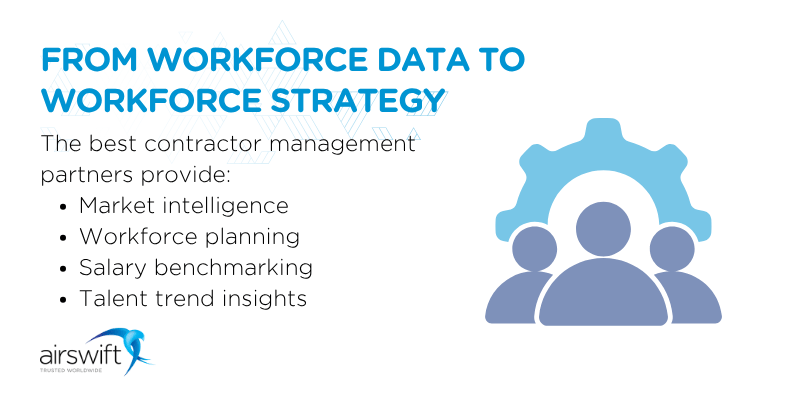
Finally, the most effective contractor management providers are not just administrators; they act as strategic partners to shape workforce strategy around the energy transition and changing market dynamics.
What advisory support do workforce management services include?
- Workforce planning for new energy projects, from offshore wind and solar to hydrogen and grid modernisation.
- Salary and rate benchmarking across onshore and offshore markets to keep offers competitive.
- Insights from sector workforce reports (such as the GETI report) on mobility, retention, and skill shortages.
This blend of data, consulting, and delivery helps energy companies build contractor strategies that are realistic, future‑ready, and aligned to the energy transition across both traditional and renewable asset portfolios.
5 FAQs about global contractor management for onshore and offshore energy
1. What is “global contractor management” in the context of energy projects?
In energy, global contractor management refers to the end‑to‑end process of recruiting, engaging, paying, mobilising, and supporting contractors across multiple countries, assets, and project phases. It combines staffing, EOR, mobility, payroll, and HSE oversight to give operators a single, scalable framework for managing their contingent workforce on both onshore and offshore sites.
2. How is supporting offshore contractors different from onshore?
Offshore contractor management must factor in marine logistics, rotations, vessel or platform access, and often more intensive safety and survival training. Onshore assignments focus more on local labour law, commuting or relocation, and integration with plant or construction site routines, but both require robust compliance, payroll, and HSE processes.
3. Why do energy companies use an Employer of Record (EOR) for contractors?
Energy companies use EOR services to legally employ contractors in countries where they lack entities or HR infrastructure, while still directing day‑to‑day work. This reduces setup time, ensures local compliance, and simplifies payroll and benefits across both onshore and offshore locations.
4. How do global contractor management services help with compliance and risk?
These services help by standardising contracts, handling local tax and social security obligations, managing visas and work permits, and ensuring that safety and competency requirements are met. Centralised reporting and governance then give energy companies visibility into their extended workforce, supporting audits, ESG reporting, and internal risk management.
5. What should energy companies look for in a global contractor management partner?
They should look for deep energy sector experience, global reach, strong on‑the‑ground presence in key basins, and integrated services covering recruitment, EOR, mobility, payroll, and HSE. Evidence of high contractor satisfaction, compliance credentials, and the ability to support both onshore and offshore operations from a single, connected infrastructure are also key selection criteria.
Simplify global contractor management with Airswift
Managing contractors across onshore facilities, offshore assets, and multiple jurisdictions requires more than recruitment. Energy companies need a partner that brings together talent acquisition, contractor management, compliance, payroll, global mobility, and workforce planning in one scalable solution.
With decades of experience across oil and gas, power, and renewables, Airswift helps organisations build and manage high-performing contractor workforces throughout the project lifecycle, from FEED and construction to operations and decommissioning.
As a leading global workforce solutions provider, Airswift helps energy companies reduce administrative complexity, maintain compliance, and mobilise specialist talent quickly and efficiently.
Contact Airswift today if you need that kind of support at your energy company.