
By
Nathalia Duarte
October 23, 2025
Updated
July 3, 2026
Studies show that 80% of employee turnover is due to bad hiring decisions and in today’s talent-driven market, your interview strategy is as important as the candidates that you shortlist.
While they can help candidates feel comfortable and open up, this informal approach often leads to bias, missed opportunities, and costly hiring mistakes.
In this article, we will explore how unstructured interviews can undermine hiring outcomes and business performance and offer practical tips for improving your process.

Structured interview vs unstructured interview
An unstructured interview is a free-flowing conversation guided by the interviewer’s impulses. Each interviewer may ask whatever they feel is relevant, which can differ for every candidate, and the process is similar to an informal conversation.
A structured interview is a predetermined set of job-related questions asked to every candidate in the same order, with a standardised scoring rubric. It focuses on skills and competencies identified through job analysis.
When are unstructured interviews beneficial?
An unstructured interview can be valuable for candidates, creating a relaxed, conversational atmosphere that encourages authentic responses. When combined with a structured interview strategy and guided by an experienced interviewer, this approach can:
- Reveal deeper insights into a candidates personality and experience
- Uncover hidden skills and abilities
- Assess a candidate’s ability to improvise
This is especially effective for creative, leadership, academic, and consulting roles. However, hiring managers should remain aware of the drawbacks of relying solely on unstructured interviews.
Examples of unstructured interviews
Icebreakers: Great for rapport but risky for relevance
Questions like “Tell me about yourself”, “Walk me through your CV”, or “What brings you here today?” are common icebreakers that help build rapport and reveal personality.
While they can offer insights into cultural fit, they often drift into hobbies or personal stories, offering little job-related insight.
Instead, briefly use icebreakers to help candidates relax at the start of the interview and then transition to structured, role-specific questions.
Example: “Tell me about yourself and how your experience aligns with this role’s key requirements.”
Personality questions: Provides soft skills insight but neglects technical skills
“Are you a team player?” or “How do you handle stress?” are popular interview questions because they help gauge soft skills and cultural fit.
Although useful, relying on them alone can leave technical competencies unchecked. To make fair and informed decisions, balance these with behavioural or scenario-based questions tied to the role.
Example: “How do you handle stress when managing multiple deadlines in a content campaign?”
Portfolio reviews: Uncovers creative thinking but lacks consistency
“Show me a project you’re proud of” or “Which piece in your portfolio excites you most?” are commonly used in interviews for creative roles because they uncover design thinking and problem-solving approaches.
While these discussions provide valuable insight into creativity and style, they're lack of standardisation can lead to unfair or inconsistent comparisons. To ensure fairness and better comparisons, create a scoring rubric with clear criteria and ask structured follow-up questions.
Example: “What was your role in this project, and what measurable results did it achieve?”
Leadership "war stories": Reveals rich narratives but are difficult to measure
Questions like “What was your biggest leadership challenge?” often spark compelling stories that showcase resilience and strategic thinking, especially in leadership positions.
The downside? These narratives are hard to benchmark.
Instead, approach this by combining storytelling with structured probes.
Example: "What specific actions did you take? What metrics improved as a result?”
The negative impact of unstructured interviews on hiring
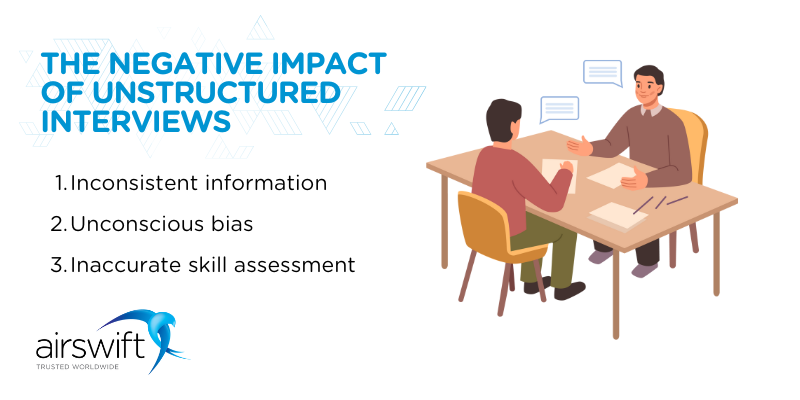
While the unstructured interview may appear approachable, it frequently introduces bias and inconsistency, ultimately failing to provide an accurate measure of candidates’ skills. This can result in highly qualified individuals being overlooked and lead to costly hiring decisions.
Research consistently demonstrates that unstructured interviews are less reliable predictors of future job performance compared to structured, evidence-based methods. Here’s why:
Inconsistency
Without standardised questions, interviewers often adopt different approaches, making candidates' responses difficult to compare. One interviewer might emphasise technical expertise, while another prioritises soft skills. This lack of alignment can result in decisions based on inconsistent and sometimes irrelevant criteria.
Unconscious bias
Unstructured interviews are susceptible to unconscious bias, where interviewers may form snap judgments about a candidate within minutes. These assumptions, often rooted in stereotypes or irrelevant beliefs about capability, can lead recruiters to favour individuals who are similar to them. The result is an unfair hiring process that hurts diversity and inclusion over time.
Inaccurate skill assessment
Interviewers can easily veer off course without a question script and spend time on superficial conversation, overlooking critical competencies. In unstructured interviews, essential skill-based questions may be missed, leading to hiring decisions that prioritise personality over technical ability. This increases the risk of selecting candidates who lack the hard skills required for a role.
How unstructured interviews can affect business outcomes
Inefficiency and time waste
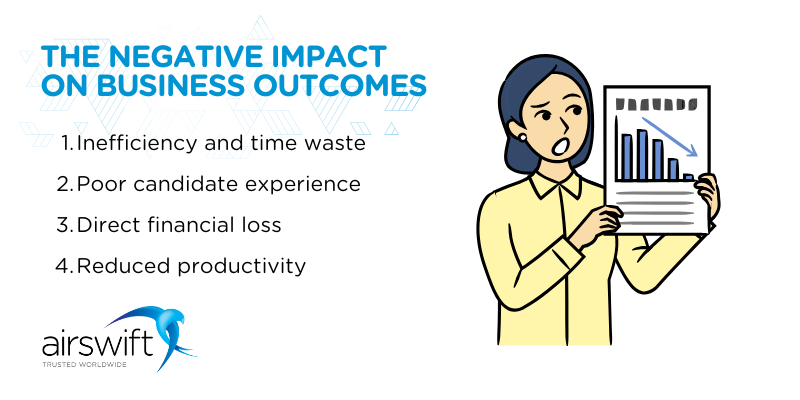
Without a clear structure, interviews often run longer than necessary, consuming valuable hours. This lack of rigour can lead to additional rounds or even repeated hiring when a poor decision is made.
Poor candidate experience
Candidates may leave the interview with mixed impressions of the role or perceive the process is unfair, potentially damaging your employer brand or reputation.
Direct financial loss
A bad hire or high turnover carries significant costs. To minimise these risks, an effective hiring process should prioritise skills assessment and cultural fit. Industry research shows that a single poor hiring decision can cost organisations nearly $17,000 per employee. For executive roles, financial losses can escalate into the hundreds of thousands.
Reduced productivity
Hiring the wrong person can result in underperformance and poor team integration, ultimately dragging down overall productivity.
Five tips to improve your interview process
1. Predetermine job competencies
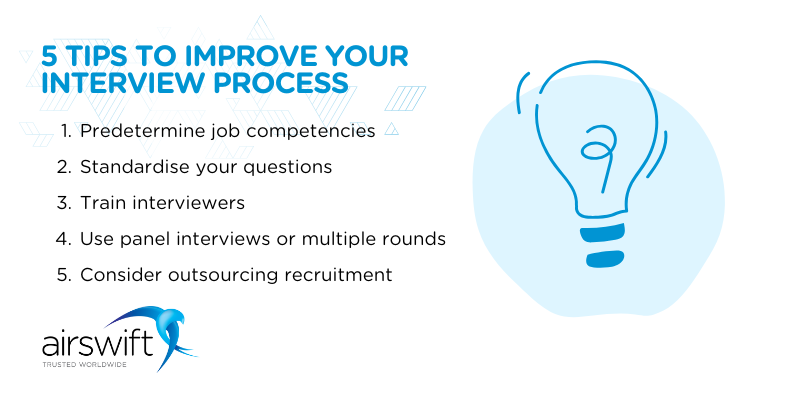
Start by identifying the key skills, traits and competencies required for the role. Consult the position’s manager to understand which abilities matter most. This insight will allow you to craft structured questions that ensure the candidates are assessed against the right criteria.
2. Standardise your questions
Research indicates that structured interviews offer superior predictive accuracy regarding job performance compared to unstructured formats. Developing a structured guide, featuring a consistent set of questions for all candidates, enhances fairness and enables more accurate, objective comparisons among applicants. Each query should be linked to the core competencies identified earlier in your process.
3. Train interviewers
Provide training programmes to reduce bias and improve consistency. Interviewers should understand the company’s guidelines, the importance of structured questioning, and common biases to avoid. Incorporating mock interviews is an excellent way to reinforce best practices.
4. Use panel interviews or multiple rounds
One way to reduce individual bias is to involve more than one evaluator. This can be done through panel interviews or sequential rounds, where each interviewer focuses on specific areas using structured questions. Another option is to interview the candidate separately and then assess the evaluation.
5. Consider outsourcing recruitment
Partnering with an objective third-party provider can help reduce bias and improve efficiency. External specialists often have the training, tools and technology to identify the right candidates, ensuring a fairer and more effective process.
Hire top technical talent with Airswift
Our Talent Acquisition services make it easy to find, attract, and secure top talent worldwide.
We manage the entire recruitment process, from identifying and engaging candidates to screening, interviewing, and onboarding, so you can focus on your core operations.
Get in touch to discover how our comprehensive talent acquisition services can support your global hiring strategy.