
By
Nathalia Duarte
July 6, 2026
Updated
July 6, 2026
Global contractor workforce solutions in energy promise flexibility, speed, and access to scarce skills across borders.
Yet in practice, they often become a maze of regulations, vendors, systems, and competing priorities that project teams struggle to navigate.
Below are the main reasons why workforce solution complexity arises in energy sectors and what sits behind it.

1. Energy projects span multiple countries, stakeholders, and phases
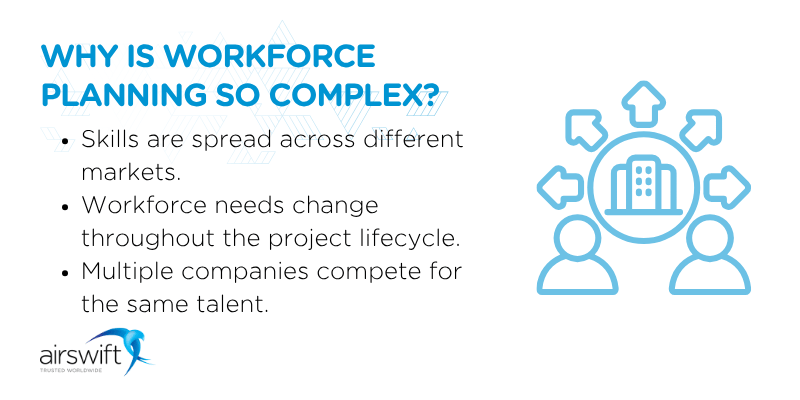
Large energy projects rarely sit neatly within one country, one company, or one project phase. A single asset can involve feasibility work in one region, engineering in another, fabrication in a third, and installation offshore somewhere else.
This leads to complexity because:
- Contractors need to be sourced from multiple markets to match where niche skills actually exist.
- Different phases (FEED, EPC, commissioning, O&M) require different contractor profiles and headcounts at different times.
- A mix of operators, EPCs, OEMs, and service companies are all competing for the same talent across overlapping timelines.
Global workforce providers emphasise project lifecycle and multi‑country coverage for exactly this reason: solutions must flex across borders and phases, or the contractor model quickly becomes fragmented.
 2. Compliance, tax, and employment law differ in every jurisdiction
One of the biggest drivers of complexity is that labour, tax, and immigration rules change country by country (and sometimes region by region within a country).
For contractor workforce solutions, that means:
-
Engagement models (contractor vs employee, local vs expat) must be designed differently in each country to avoid misclassification, permanent establishment, or tax non-compliance.
-
Payroll, social security, and mandatory benefits vary widely, requiring country‑specific processes and systems.
-
Constant regulatory updates demand ongoing monitoring and adaptation of contracts and policies.
3. Immigration, mobility, and logistics turn workforce planning into a chess game
Moving contractors across borders isn’t just a travel booking exercise; it’s a regulated process with lead times, quotas, and documentation requirements that differ across destinations.
Complexity ramps up when:
- Project timelines assume immediate availability, but visas, work permits, and offshore certifications take weeks or months.
- Contractors must rotate between onshore yards, offshore installations, and home locations, each with its own travel, accommodation, and safety rules.
- Last minute scope changes demand rapid remobilisation or reallocation of people, often across borders.
Case studies and mobility content underline how much effort goes into coordinating travel, permits, and compliance to keep projects staffed—especially across EMEA, APAC, and the Americas. When this mobility layer is underestimated, global contractor solutions quickly feel chaotic to local project teams.
4. Scarce technical skills and energy transition pressures collide
The energy sector is experiencing overlapping pressures: ongoing demand in conventional oil and gas, rapid growth in renewables, and a global shift towards decarbonisation. This tightens the global skills market and makes workforce solutions inherently more complex.
Key factors include:
- A structural shortage of experienced engineers and technicians in both traditional and renewable segments.
- New technologies (offshore wind, grid scale storage, hydrogen) requiring skills that aren’t yet widely available.
- A workforce in transition, with many energy professionals considering career changes or new sectors.
To ease these symptoms, companies must draw on global talent pools and create flexible staffing models to secure the right expertise at the right time. That hunt across multiple markets, combined with tight supply, is another reason global contractor strategies become intricate very quickly.
5. Multiple internal stakeholders pull workforce solutions in different directions
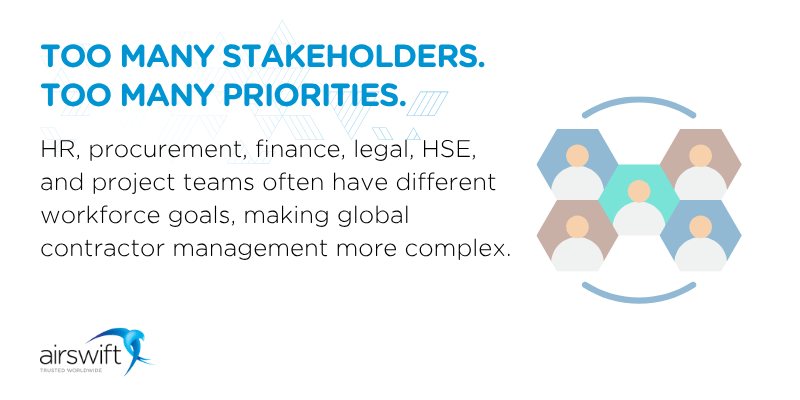
Inside an energy company, global contractor workforce decisions are rarely owned by a single function. HR, procurement, legal, finance, HSE, and project management all have legitimate but sometimes competing priorities.
This creates complexity because:
- Procurement may focus on rate cards and vendor consolidation, while project managers focus on speed and quality of candidates.
- HR teams prioritise consistent policies, fairness, and retention, while finance cares about cost visibility and budget control.
- Legal and compliance teams push for risk averse structures that can slow down hiring or limit flexibility.
Look for a strategic partner that aligns workforce solutions to each client’s unique needs, precisely to help balance these tensions and create a coherent approach. Without that alignment, different parts of the organisation make local decisions that add up to a globally inconsistent contractor model.
6. Onshore and offshore operations have very different realities
Managing contractors on a refinery turnaround in Texas is not the same as staffing an offshore wind farm in the North Sea or an FPSO off West Africa. Yet global solutions must cover all of these environments under one umbrella.
Differences include:
- Offshore work often involves tighter safety regimes, marine logistics, and specific certifications (for example, offshore survival, vessel access).
- Remote onshore sites may require camp accommodation, rotational schedules, and local community engagement.
- Urban onshore roles can look more like “traditional” employment, with daily commuting and strong local labour regulations.
To address this, look for providers that segment services by industry and environment (oil and gas, offshore marine, offshore wind, power, and onshore renewables), while still offering centralised contractor management. Integrating these distinct realities into one global solution is complex but necessary.
7. Technology, systems, and data need to work across borders
Another layer of complexity comes from the systems used to manage contractors: applicant tracking systems, VMS platforms, HRIS, payroll engines, time‑writing tools, and HSE systems.
Challenges include:
- Integrating client systems with provider platforms across multiple countries and entities.
- Ensuring data privacy and security compliance (for example, GDPR) when contractor data is stored and processed globally.
- Producing consolidated analytics on headcount, cost, and performance when data lives in different tools and formats.
Global workforce players respond with standardised processes and reporting layers on top of local systems, but aligning technology stacks and data flows is still a non‑trivial task. That’s why “simple” questions like “how many contractors do we have on this project globally?” can be surprisingly hard to answer without a mature solution.
8. Culture, communication, and expectations differ across regions
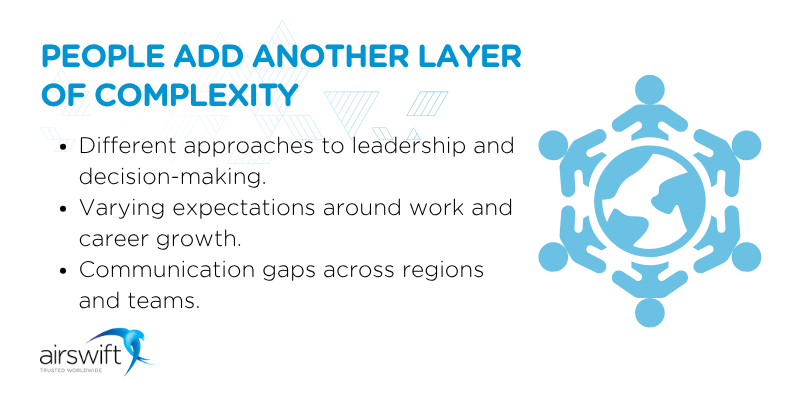
Finally, people aspects add their own complexity. Hiring, leading, and retaining a contractor workforce that spans multiple cultures, languages, and expectations is a challenge in itself.
Common friction points include:
- Different norms around hierarchy, decision making, and feedback between regions.
- Varied expectations around work-life balance, rotations, and career development.
- Communication gaps between central teams and local sites, especially when contractors report operationally to one team and administratively to another.
Investing in cultural awareness, region-specific management approaches, and clear communication frameworks reduce misunderstandings and foster engagement across global teams. Without that, even technically sound workforce solutions can feel misaligned and hard to manage on the ground.
5 FAQs about global contractor workforce complexity in energy
1. Why are global contractor workforce solutions more complex in energy than in other industries?
Energy projects combine safety‑critical work, remote and offshore locations, and heavy regulation with long project lifecycles across multiple countries. This mix amplifies every underlying complexity, legal, technical, logistical, and cultural, compared with many other sectors.
2. How does an Employer of Record (EOR) help simplify global contractor management?
An EoR acts as the legal employer for contractors in each country, handling contracts, payroll, tax, and statutory benefits while the energy company directs day-to-day work. This reduces the need for clients to build their own entities and HR infrastructure in every location, simplifying compliance and administration.
3. What can energy companies do internally to reduce workforce complexity?
They can standardise global policies, clarify ownership between HR, procurement, and project teams, and use data to guide where and how they engage contractors. Many organisations also consolidate vendors, choosing a small number of strategic workforce partners instead of many local agencies.
4. How important is choosing the right partner for global contractor workforce solutions?
Choosing the right partner is critical because very few energy companies have the scale and expertise to handle global recruiting, compliance, mobility, and contractor care on their own. A good partner brings established infrastructure, local knowledge, and proven processes, which significantly reduces operational and compliance risk.
5. Will global contractor workforce solutions get simpler or more complex in the future?
Most evidence suggests they will remain complex, but better structured. As the energy transition accelerates and projects become more global, companies will likely rely more on integrated workforce partners and standardised frameworks to manage that complexity rather than eliminate it.
Partner with Airswift to simplify global workforce management in energy
Global contractor workforce solutions are only as effective as the strategy behind them. Energy companies that take a strategic approach to workforce management (integrating talent acquisition, compliance, mobility, and contractor management) are better equipped to deliver projects on time, access scarce skills, and scale across borders while minimising risk.
Airswift helps simplify the complexities of managing a global energy workforce through integrated solutions, including Employer of Record (EOR), contractor management, payroll, compliance, and global mobility support.
By connecting organisations with top talent and streamlining workforce operations, we enable businesses to focus on project delivery while building a compliant, agile workforce ready to support long-term growth.
Contact us today to learn how our global workforce solutions can help you build and manage a high-performing international workforce.