
By
Nathalia Duarte
June 15, 2026
Updated
June 15, 2026
Oil and gas professionals are no longer motivated by pay alone. Amidst a volatile and competitive global market, we've found that candidates want to work for companies that can give them long‑term security, purpose, and flexibility.
From clear career development pathways to ESG commitments, this article covers 10 things today’s oil and gas workers value most when choosing an employer.

1. Clear career paths and progression
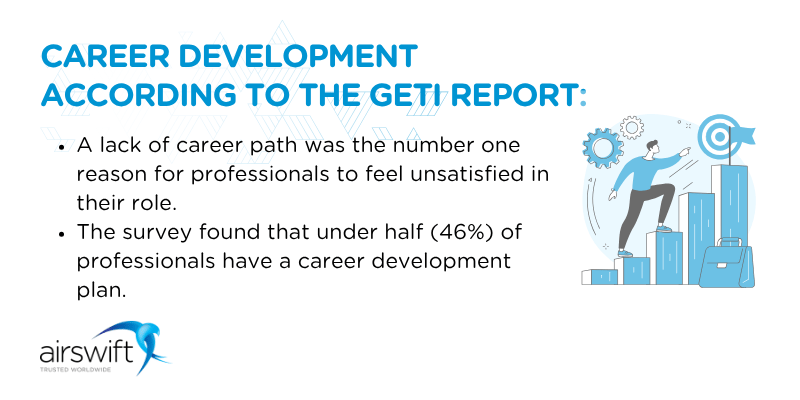
The oil and gas industry offers complex projects and advanced engineering challenges; however, fewer than half of its employees have a clear career development plan.
GETI found that the lack of a clear career path was the leading cause of job dissatisfaction and that oil and gas employees increasingly expect structured progression, transparent promotion criteria, and opportunities to move into leadership or adjacent technical disciplines over time.
Companies that invest in succession planning, internal mobility, and robust performance frameworks stand out strongly in talent‑short markets.
2. Skills development and continuous learning
Upskilling is now a core expectation, particularly as digitalisation, automation, and the energy transition reshape technical roles. According to GETI 2026, 57% of professionals value industry training as part of career development, yet only 43% of companies offer it.
Engineers, technicians, and project professionals want access to training, mentorship, and certifications that keep their skills relevant across both traditional and emerging energy segments.
How can companies help their employees upskill?
- Fund technical certifications and cross‑disciplinary learning (e.g., from oil and gas into renewables and low‑carbon projects).
- Build internal academies and mentoring programs to accelerate learning on live projects.
- Encourage skills‑first career moves, rather than limiting mobility to narrow sector experience.
This “skills‑first, sector‑second” mindset is particularly attractive to candidates weighing whether to stay in oil and gas or pivot fully into alternative energy roles.
3. Safety culture that goes beyond compliance
Safety has always been a license to operate in oil and gas, but candidates now look for a safety culture they can feel, not just policies on paper. They are scrutinising how companies design work, invest in equipment, and respond when something goes wrong.
Here are some examples of how employers can embed safety into their culture:
- Embed safety in every stage of project planning, resourcing, and execution, onshore and offshore.
- Provide comprehensive training and refreshers, not just one‑off inductions.
- Showcase incident learning, near‑miss reporting, and leadership accountability, reinforcing that every worker has the right to stop unsafe work.
A demonstrably safety‑focused environment is especially important for contractors and project‑based workers who may move frequently between operators and locations.
4. Flexible and consistent workdays 
Energy projects demand long hours, remote locations, and rotational schedules, but talent increasingly expects more flexibility and predictability around how work is structured. Candidates want to understand rotation patterns, leave policies, and options for hybrid or flexible arrangements where roles allow.
Forward-thinking oil and gas employers are:
- Designing rotations and rosters that support rest, well-being, and family time, not just project efficiency.
- Introducing hybrid work and flexible hours for office‑based engineering and project roles.
- Offering choices where possible (e.g., different rotation schemes or base locations) to reflect diverse personal circumstances.
5. Strong ESG and sustainability credentials
Many professionals, especially younger generations, want to work for employers whose values align with their own regarding climate, community, and governance.
Even within oil and gas, candidates are asking how companies are contributing to the energy transition, reducing emissions, and investing in cleaner technologies.
Employers that connect traditional oil and gas expertise to a long‑term net-zero road map are better positioned to attract talent that might otherwise leave the sector.
What stands out to job seekers:
- Clear ESG strategies with measurable targets on decarbonisation, safety, and community impact.
- Visible investment in technologies and projects that support net-zero and cleaner operations.
- Transparent reporting and open communication about challenges as well as progress.
6. Inclusive culture and real diversity commitments
Diversity, equity and inclusion are no longer “nice-to-haves” in candidate decision‑making.
Professionals want to see teams that reflect a mix of genders, ages, backgrounds, and experiences – and they want proof that everyone can progress on equal terms.
Candidates look for:
- Inclusive leadership behaviors and zero‑tolerance policies on discrimination and harassment.
- Practical support for underrepresented groups, such as return‑to‑work programs, mentoring, and flexible work options.
- Data‑driven progress on diversity in leadership and technical roles.
In a sector facing acute skills shortages, tapping into underrepresented talent pools is both a moral and commercial imperative.
What should inclusive leadership look like in STEM sectors? Listen to our podcast with Johnathan Stutz, DEI leadership consultant and former DEI leader at Microsoft and Amazon.
7. High‑quality project experience and technology
Oil and gas professionals want to stretch their abilities and contribute to large-scale, technically challenging work. They want this to add weight to their CV and expose them to modern tools and methods.
It makes sense that they're drawn to employers who invest in digital technologies, advanced engineering, and complex international projects.
Attractive employers typically:
- Operate or partner on flagship projects across upstream, midstream, and downstream, onshore and offshore.
- Utlise advanced digital tools, data platforms, and automation to improve decision‑making and safety.
- Offer cross‑project mobility so individuals can experience different assets, geographies, and phases of the project lifecycle.
8. Transparent, human‑centered recruitment and onboarding
The recruitment experience itself is a strong signal of what it will be like to work for you. Job seekers want timely communication, honest feedback, and a process that respects their time and privacy from first contact through to mobilisation.
Best‑practice employers and their workforce partners:
- Provide clear information about roles, locations, rotations, and benefits upfront.
- Keep candidates updated at each stage, especially for roles requiring complex visa and mobilisation processes.
- Offer structured onboarding that covers culture, safety, and expectations, not just paperwork.
In a market where specialist recruiters and workforce solutions providers support thousands of placements, a polished candidate experience can significantly boost employer reputation.
9. International mobility and varied assignment options
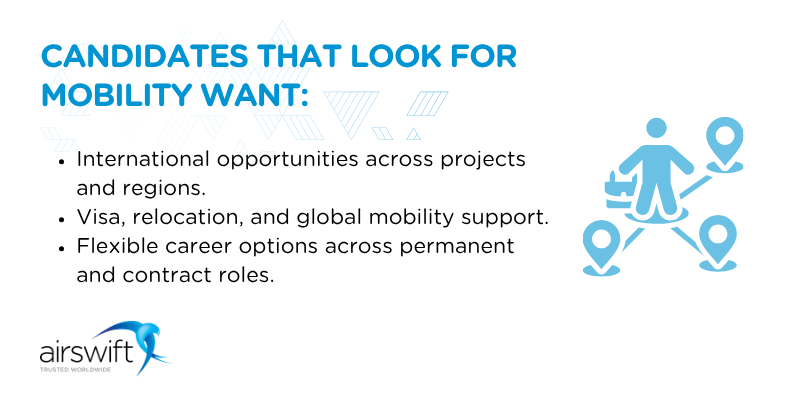
Oil and gas is inherently global, and many professionals choose the sector for the chance to work across multiple locations. They value employers who can offer international assignments, secure visa support, and structured mobility programs.
What candidates are looking for:
- Opportunities to move between regions and projects over the course of their career.
- Robust global mobility support for visas, work permits, relocation, and family moves where relevant.
- Options to switch between permanent, contract, and project‑based roles as their life circumstances evolve.
Employers that partner with global workforce specialists are often better placed to provide this variety and handle the complexity behind the scenes.
10. Trustworthy, competitive total rewards packages
While salary is only one part of the decision, candidates still care deeply about the full rewards package – and they expect transparency and fairness. Benefits, allowances, and protections often carry as much weight as base pay, particularly for mobile and remote roles.
In practice, that means:
- Clear communication of allowances (housing, travel, hardship, offshore bonuses), insurance, and pensions or end‑of‑service benefits.
- Recognition of project‑based realities, including downtime, standby arrangements, and completion bonuses.
- Internal equity and regular benchmarking so employees can trust that the offers are competitive with the wider energy market.
Recruit and retain top oil and gas talent
Airswift helps organisations attract, mobilise, and retain skilled professionals across upstream, midstream, downstream, and emerging energy sectors.
With expertise in global workforce solutions, contractor management, compliance, and international mobility, we help businesses build agile, future-ready teams that can deliver projects safely, efficiently, and at scale.
Connect with talent acquisition specialists to learn how we can support your next project.