By
Natalie Colvin
July 2, 2026
Updated
July 2, 2026
Pairing a Managed Service Provider (MSP) with a Vendor Management System (VMS) turns a fragmented contingent workforce program into a single, data‑driven, scalable engine for acquiring and managing non-permanent talent.
Below are 11 practical benefits of combining MSP expertise and capabilities with VMS technology.
1. End‑to‑end visibility of your extended workforce
An MSP‑VMS model gives you a single source of truth for who is working for you, where they are, what they do, and what they cost. A VMS consolidates requisitions, worker records, time sheets, and invoices, while the MSP designs the workflows and governance that keep data clean and actionable.
For organisations that have quietly grown beyond 50 to 125 contractors, this level of visibility is often the tipping point that makes structured MSP support essential. With real‑time dashboards, leadership can finally answer basic questions like total contractor headcount, spend by business unit, and supplier performance without a manual data chase.
Businesses that leverage this hybrid or integrated approach towards extended workforce management often experience significant gains, such as 35% higher cost savings, 55% higher rates of contractor compliance, and a 63% overall higher quality of candidate.
2. Streamlined hiring and faster time‑to‑fill
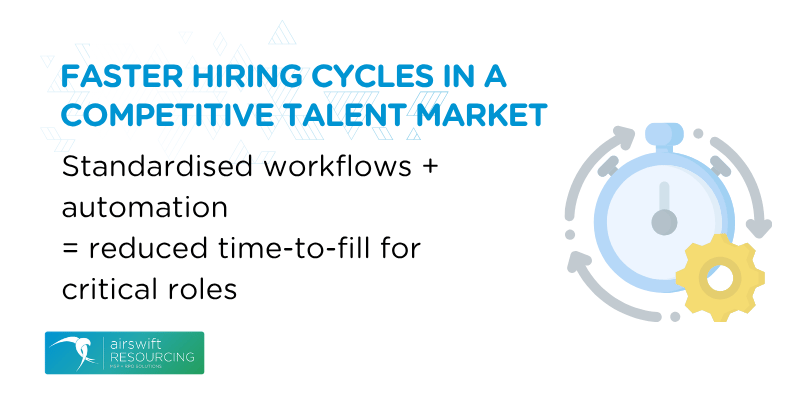
When an MSP runs your contingent program through a VMS, the full cycle (from requisition to onboarding) is standardised and accelerated. The MSP defines workflows, SLAs, and approval paths; the VMS automates them so hiring managers can raise requests, review shortlists, and approve offers in fewer steps.
MSP programs that embed a VMS consistently reduce time‑to‑hire and minimise ramp‑up time, so contingent workers become productive sooner. In markets where niche STEM skills are scarce and candidates have multiple options, shaving days off each hiring cycle can directly protect project timelines and revenue.
Also, in an age when artificial intelligence (AI) has become an omnipresent attribute of modern business, the dynamic relationship between an MSP and a VMS platform is deepened through predictive analytics, agentic AI workflows, and the development of skills taxonomies.
3. Sustainable cost optimisation, not one‑off savings
A combined MSP‑VMS solution moves you from sporadic rate negotiations to continuous, measurable cost optimisation. The MSP benchmarks rates, rationalises suppliers, and designs pricing models, while the VMS tracks every transaction and feeds spend analytics back into the program.
Ardent Partners research shows that businesses leveraging MSPs drive 65% higher cost savings year‑over‑year compared to those without structured programs. Airswift Resourcing typically helps clients achieve around 6% annual savings, with up to 8–10% in year one, by focusing on structural efficiencies rather than just cutting rates.
4. Stronger compliance and reduced risk
Regulatory compliance risks for contingent workers increases as you scale across markets. An MSP standardises contracts, vetting, worker classification, and documentation, while a VMS enforces those standards through rules‑based workflows and audit trails while providing a groundswell of automation to ensure that current and future hiring maintains a stringent level of compliance.
This dual approach helps mitigate misclassification risk, unapproved site access, and inconsistent background checks - common pain points for growing contingent programs.
5. Centralised supplier management and performance control
Supplier lists tend to grow organically, leading to inconsistent rates, terms, and service quality, as well as ballooning costs due to maverick hiring outside of preferred and trusted staffing supplier agreements.
An MSP rationalises this supplier base into a fit‑for‑purpose ecosystem, with clear performance metrics, commercial frameworks, and escalation paths.
A VMS then operationalises that strategy, routing requisitions to the right suppliers, tracking fill rates and time‑to‑submit, and flagging underperformance in real time.
6. Better hiring manager and candidate experiences
In many organisations, contingent hiring experiences vary wildly between business units. An MSP introduces consistent support for hiring managers; clear entry points, defined SLAs, and local program teams, while the VMS provides a user‑friendly portal for creating requisitions, reviewing candidates, and approving timesheets.
7. Data‑driven workforce strategy and analytics
A key benefit of pairing an MSP with a VMS is the ability to turn workforce data into strategic intelligence. The VMS captures granular data on demand, submissions, rates, tenure, and performance; the MSP interprets it through the lens of market trends, skills scarcity, and business priorities.
As VMS platforms continue to integrate AI into their workflows and core functionality, utilisation of these solutions will result in stronger, more actionable workforce and skills intelligence.
8. Scalable, future‑ready technology foundation
Managing a growing contingent workforce on spreadsheets and email quickly becomes a liability.
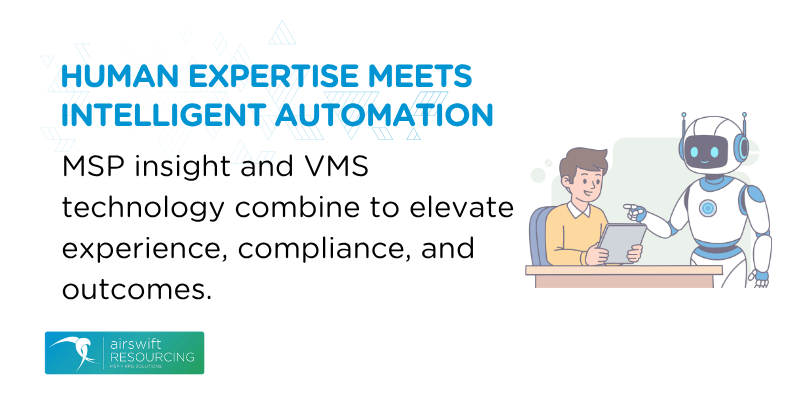
A VMS provides the configurable workflows, integrations, and user experiences needed to handle requisitions, approvals, time capture, and billing at scale, while the MSP ensures that the technology is configured around your operating model rather than forcing you into a generic template.
Modern MSP models increasingly act as a nexus between VMS, HRIS/HCM, ATS, and finance platforms, creating a connected tech ecosystem. This enables organisations to layer in AI‑driven sourcing, predictive analytics, and skills matching as their maturity grows.
9. Human‑centric programs backed by automation
One risk with technology‑led programs is that the experience becomes overly transactional. One approach is to balance automation with a human‑centric MSP team that understands local markets, site conditions, and candidate expectations.
In practice, that means the VMS handles repeatable tasks,like routing requisitions, tracking compliance documents, and processing time sheets,while the MSP focuses on stakeholder engagement, workforce planning, and problem solving on the ground. For high‑stakes environments such as offshore platforms or nuclear facilities, this blend of digital efficiency and human judgment is critical to safety, retention, and culture.
10. Easier global expansion and market entry
Global projects often stall because setting up entities, understanding labor laws, and building local vendor networks takes time and capital. A global MSP with integrated EOR services can engage workers compliantly in new markets before you establish a full legal and HR footprint, while the VMS keeps all those engagements visible in a single program.
Services such as EOR, payroll, and mobility can be folded into MSP programs to support rapid entry into new countries without sacrificing compliance or worker experience. For organisations in energy, renewables, and infrastructure, that creates a repeatable, low‑friction model for scaling projects across regions.
11. Alignment between contingent workforce and business goals
Finally, pairing an MSP with a VMS elevates contingent labor from a tactical gap‑filler to a core part of workforce strategy. The MSP acts as a strategic partner, aligning talent models with your growth, digital transformation, and sustainability goals, while the VMS provides the data and governance needed to measure progress.
Mature MSP programs help clients shift toward skills‑based hiring, improve diversity, and support innovation by ensuring the right mix of permanent, contingent, and SOW talent.
Frequently asked questions about pairing an MSP with a VMS
1. What is the difference between an MSP and a VMS, and why use both together?
A Managed Service Provider (MSP) is a service partner that designs, runs, and optimises your contingent workforce program, while a Vendor Management System (VMS) is the technology platform that automates workflows, data capture, and reporting.
Using both together gives you expert human program management plus a single system of record, so you gain better visibility, control, and cost savings than using either in isolation.
2. What are the main business benefits of pairing an MSP with a VMS?
Organisations that pair an MSP with a VMS typically see end‑to‑end visibility of contingent workers, faster time‑to‑fill, sustainable cost optimisation, stronger compliance, and more consistent supplier performance.
This combination also improves hiring‑manager and candidate experience and enables more data‑driven workforce decisions by centralising requisitions, worker records, time, and invoices in one program.
3. How does an MSP + VMS model improve compliance and reduce risk?
An MSP standardises contracts, vetting, worker classification, and background checks, while the VMS enforces those rules through configurable workflows, documentation requirements, and audit trails.
Together, they reduce misclassification, off‑program hiring, inconsistent onboarding, and gaps in site access or credential tracking, which is especially important in regulated sectors like energy, infrastructure, and healthcare.
4. When does it make sense to move from ad‑hoc vendor management to an MSP‑VMS program?
An MSP‑VMS model becomes valuable when contingent headcount and supplier complexity grow to the point where spreadsheets and email can no longer provide reliable visibility, consistent pricing, or governance.
Signs you are ready include 50+ contractors, rising spend across multiple business units, frequent off‑contract hiring, inconsistent rates, and difficulty answering basic questions about who is working where, for how long, and at what cost.
5. How does an MSP‑VMS solution support global or multi‑site expansion?
A global MSP with integrated VMS and Employer of Record capabilities can engage contractors compliantly in new countries, manage local suppliers, and standardise processes across sites while keeping all data in a single platform.
This allows organisations to enter new markets faster, manage immigration and payroll more consistently, and scale contingent programs without building full internal HR and procurement infrastructure in every location.
Why choose Airswift Resourcing for your MSP + VMS strategy?
Combining sector expertise, global delivery capabilities, and seamless integration with leading VMS platforms, we empower businesses to gain full visibility across their workforce, reduce costs through sustainable optimisation, access high-quality STEM talent at scale, and future-proof their workforce strategy.
Speak to an MSP specialist today to learn how we can support your contingent workforce management.