By
Diyaa Mani
April 23, 2026
Updated
September 9, 2026
Fly‑in fly‑out (FIFO) jobs in Australia continue to play a vital role in keeping large‑scale energy, mining, and infrastructure projects running in 2026.
As projects move further into remote and hard‑to‑staff locations, companies increasingly rely on skilled professionals who can be flown in for fixed work rotations rather than hired locally.
FIFO roles are especially common in mining, oil and gas, LNG, and major infrastructure projects, where the right technical skills are often unavailable near site locations. In the Australia alone, FIFO workers routinely earn between A$120,000 and A$200,000 per year, with specialist roles earning significantly more once overtime and allowances are included.

Why FIFO jobs are in high demand in Australia
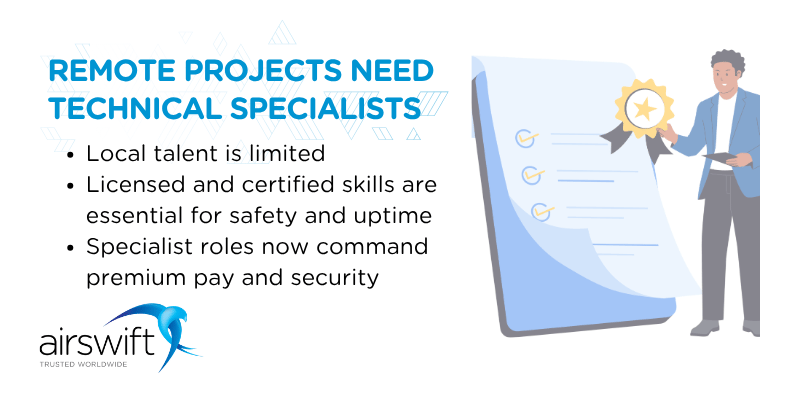
There are three main reasons FIFO jobs continue to gain attention:
- Projects are becoming more technical. Automation, electrification, and advanced equipment require licensed and highly trained specialists rather than general labour.
- Remote locations limit local hiring. Many mining sites, offshore facilities, and infrastructure projects are far from major population centres, making FIFO a practical necessity.
- Global skills shortages persist. Across engineering, mechanical, and electrical trades, demand is outpacing supply, pushing employers to search nationally or internationally for talent.
Because of this, professionals with the right certifications often command higher pay and stronger job security in FIFO roles than in equivalent city‑based positions.
Most in-demand FIFO jobs in Australia
.png?width=800&height=400&name=The%20site%20ready%20skills%20employers%20need%20most%20(2).png "Secure FIFO talent before shortages bite")
Industrial electrician
Industrial electricians install, maintain, and fix electrical systems at mines, processing plants, and energy facilities. This includes working on power distribution, motors, switchboards, and, in many cases, high‑voltage (HV) equipment.
Demand for FIFO electricians is high because electrical systems are critical to site safety and production. Delays or failures can stop an entire operation.
Estimated 2026 pay
AUD$130,000–A$170,000+ per year, depending on experience and specialisations.
Typical requirements
- Electrical trade qualification and an active licence
- High‑voltage switching or instrumentation tickets for advanced roles
- Site safety training and First Aid/CPR
Heavy diesel fitter / Mechanic
Heavy diesel fitters keep large mobile equipment running, such as dump trucks, drills, loaders, and excavators. Their work directly affects productivity, as equipment downtime can cost projects millions.
These roles are consistently listed among the highest‑paid FIFO trades due to the combination of skill, responsibility, and remote working conditions.
Estimated pay
AUD$140,000–A$190,000+ per year, with overtime and site allowances commonly offered.
Typical requirements
- Trade qualification in heavy diesel or mechanical fitting
- Experience with mining or industrial equipment
- Ability to pass site medical and drug/alcohol screening
Boilermaker / Welder
FIFO boilermakers and welders handle fabrication and repairs on steel structures, pipelines, and heavy equipment. They are especially in demand during shutdowns and major construction phases.
Certified welders with experience in pressure welding or LNG and mining projects are particularly sought after.
Estimated pay
AUD$135,000–A$180,000+ per year, with shutdown work often exceeding base earnings.
Typical requirements
- Fabrication or welding trade qualification
- Coded welding tickets for specialist work
- Confined space and working‑at‑heights certification
Site medic / Remote nurse
Site medics and nurses are responsible for on‑site medical care, emergency response, and worker health monitoring. Many FIFO sites operate far from hospitals, making these roles critical to safety and compliance.
The importance of health and well-being in remote work environments has increased demand for qualified FIFO medical professionals.
Estimated 2026 pay
AUD$150,000–A$180,000+ per year, depending on location and risk exposure.
Typical requirements
- Registered Nurse or Paramedic qualification
- Advanced First Aid and trauma response training
- Experience in emergency, remote, or occupational health settings
Heavy equipment operator
Heavy equipment operators handle haul trucks, excavators, dozers, and drilling equipment. Modern sites rely on skilled operators who understand safety systems, production targets, and equipment limits.
As machinery becomes more advanced, operators are increasingly viewed as technical specialists rather than entry‑level workers.
Estimated 2026 pay
AUD$100,000–A$150,000+ per year, with higher earnings for multi‑skilled operators.
Typical requirements
- Relevant heavy vehicle or machinery licence
- Site‑specific equipment competency
- Mining or construction safety induction
What this means for employers and workers
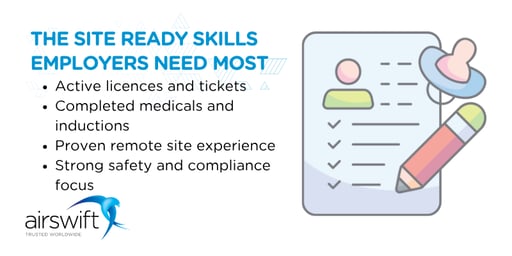
For employers, the challenge is no longer finding workers; it is finding qualified, site‑ready professionals who can mobilise quickly and work safely in remote conditions. Skills shortages mean delays are costly, and the wrong hire can put entire projects at risk.
For workers, FIFO roles offer:
- Strong earning potential
- Long‑term global demand
- Experience that transfers across mining, energy, and infrastructure sectors
However, success in FIFO work depends on maintaining licences, staying medically fit, and adapting to the lifestyle demands of remote rotations.
Mobilise critical FIFO talent with Airswift
Airswift’s Global Energy Talent Index (GETI) consistently shows that skills shortages, an ageing workforce, and limited access to site‑ready STEM talent are among the biggest risks facing energy and infrastructure projects worldwide. At the same time, GETI data highlights that experienced technical professionals remain open to mobile and rotation‑based work when roles are well structured, compliant, and competitively packaged.
This is where FIFO work becomes a strategic advantage rather than a stop‑gap. Employers that plan early, understand talent expectations, and partner with workforce specialists are better positioned to secure critical skills before delays impact safety, cost, or production.
If you’re planning upcoming mining projects, facing hard‑to‑fill technical roles, or need workforce insights to stay ahead of market pressure, Airswift can help.
Speak to our team in Australia to get your projects off the ground quickly and compliantly.