
By
Alicia Edwards
June 18, 2026
Updated
July 10, 2026
The oil and gas industry employs millions of people globally, including over 6 million in direct roles and tens of millions more supported through its wider supply chain, according to the World Resources Institute,
This varies from roughnecks on drilling rigs to petroleum engineers designing extraction systems.
This guide covers everything you need to know about working in the oil and gas industry: the positions available, the qualifications required, and the exact steps to land your first role.
Key takeaways: what this guide covers
- Whether oil and gas is a good career choice based on lifestyle, pay potential, and long‑term demand
- The most common entry‑level, technical, and professional roles in the oil and gas industry
- What qualifications and safety certifications are typically required to get hired
- How upstream, midstream, and downstream roles differ and which may suit your background
- Where oil and gas jobs are most commonly located in the US and internationally
- Practical steps to improve your chances of landing your first oil and gas role
- Common mistakes candidates make when applying and how to avoid them
Is oil and gas a good career choice?
Working in the oil and gas industry offers some of the most competitive salaries in the energy sector, along with strong long-term demand for technical and operational talent.
The industry spans upstream (exploration and production), midstream (transportation and storage), and downstream (refining and distribution), meaning positions in the oil field range from remote rig sites to corporate offices and processing facilities.
Even as the energy transition reshapes the market, oil and gas companies continue recruiting aggressively for engineers, technicians, field operators, and support roles to maintain global supply.
The realities of working in oil and gas (what to know before you commit)
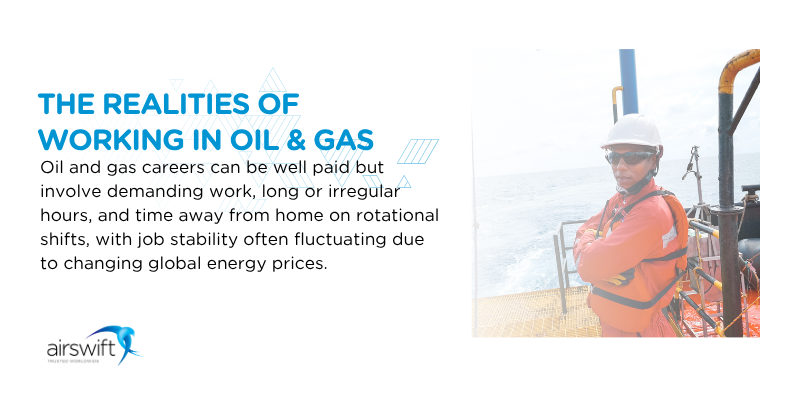
While oil and gas careers can be financially rewarding, they are not the right fit for everyone. The work can be physically demanding, schedules are often long and irregular, and employment levels can rise and fall with global energy prices.
Many field roles require extended periods away from home, particularly in upstream and offshore environments. Work is commonly organised around rotational shifts, meaning weeks on site followed by time off, rather than a traditional Monday–Friday schedule.
It’s also important to understand that oil and gas is a cyclical industry. Hiring tends to increase during periods of high commodity prices and slow during downturns. Candidates who succeed long‑term are typically those who are flexible, mobile, and prepared to navigate periods of change between projects or contracts.
LEARN MORE: 10 things oil and gas workers want from employers (besides salary)
Positions in the oil field: what jobs are available?
The oil and gas industry is broader than most people realise. Before applying, it helps to understand where the roles sit across the value chain.
Entry-level and field positions
Entry-level roles typically require a high school diploma or GED, physical fitness, and a willingness to work long rotational hours. Common starting points include:- Floorhand / Roughneck: The most common entry-level rig position; requires a high school diploma and basic safety certifications
- Roustabout: General labourer on a rig or platform; no formal qualifications typically required
- Mechanic Helper: Supports equipment maintenance; requires a high school diploma or GED
- Mud Logger: Monitors drilling fluid and formation data; considered a relatively accessible entry point
- Field Technician: Monitors gauges, flow meters, and equipment; 1 to 2 years of experience preferred, but entry-level roles exist
Technical and professional roles (with salaries)
For candidates with degrees or specialist training, the oil and gas industry offers a range of higher-paying technical and professional roles.
See below for top technical and professional jobs and their salaries according to the 2026 GETI Report.:
| Role Category | Job Title | Average Salary (USD) |
| Engineering | Drilling Engineer |
$116,000
|
| Engineering | Mechanical Engineer |
$96,000
|
| Engineering | Process Engineer |
$106,000
|
| Geoscience |
Geoscientist / Geologist (Geophysicist)
|
$129,000
|
| HSE |
HSE Specialist / HSE Manager
|
$101,000
|
| Engineering |
Pipeline Engineer (Civil/Construction equivalent)
|
$100,000–$105,000
|
| Project Management |
Project Manager
|
$89,000
|
| Project Management |
Construction Manager
|
$100,000
|
Is an oil and gas career right for you? Take some time to think first.
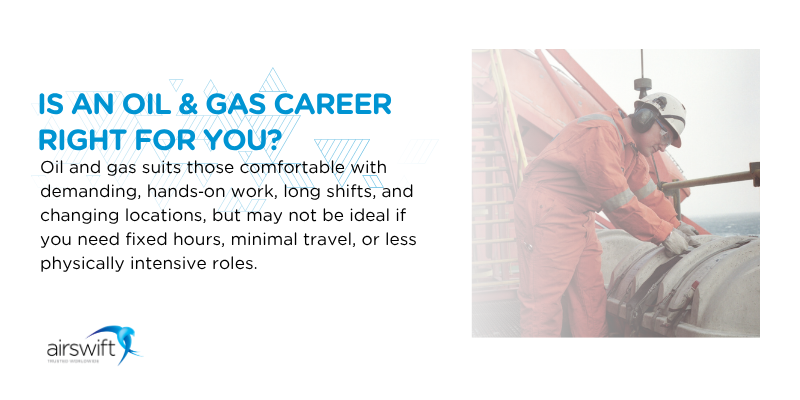
Oil and gas will suit candidates who:
-
Are comfortable working long shifts in physically demanding or industrial environments
-
Can adapt quickly to new locations, teams, and project timelines
-
Take safety seriously and follow procedures consistently
-
Are motivated by practical, hands‑on work rather than predictable office routines
This career path may not be a good fit if you require fixed working hours, are unable to relocate or travel, or are looking for a role with minimal physical or environmental demands.
 How to get a job in oil and gas: Step-by-step guide
1. Meet the baseline requirements
Before applying for oilfield positions, make sure you can satisfy standard industry requirements:
-
Be at least 18 years old with a valid driver's licence (CDL is a plus)
-
Pass a pre-employment drug test and medical assessment
-
Be physically able to lift 50 lbs repeatedly and work in outdoor conditions
-
Be willing to work 12–14 hour shifts on rotational schedules
-
Be open to relocation. The major oil-producing regions include Texas, North Dakota, New Mexico, and internationally in the Middle East, West Africa, and Southeast Asia
2. Understand which segment fits you
Oil and gas is divided into upstream, midstream, and downstream. Upstream (exploration and drilling) tends to have the most field-based, physically demanding roles. Midstream and downstream offer more plant, pipeline, and logistics-based positions. Knowing which segment suits your background helps you target the right employers from day one.
3. Build relevant qualifications
What qualifications do you need for oil and gas jobs? You don't need a degree to get started in the oil field, but targeted training gives you a measurable edge over other applicants. Consider:
-
Vocational / trade school programmes in oilfield technology, instrumentation, or electrical systems
-
Safety certifications such as OSHA 10/30, H2S Alive, First Aid/CPR, and BOSIET (for offshore roles)
-
Industry-recognised online courses through providers like IADC (International Association of Drilling Contractors) or OPITO
-
A degree in petroleum, mechanical, or chemical engineering if pursuing professional or corporate roles
Specialist recruitment agencies often list the certifications most requested by their client companies - checking current job postings is one of the fastest ways to identify what qualifications matter most in your target region.
Certification requirements can vary by country, employer, and whether a role is onshore or offshore. Before enrolling in training, review current job postings in your target region or speak with a specialist recruiter to confirm which certifications are genuinely required - and which are optional or employer‑provided.
4. Choose your target location
Oil and gas employment is geographically concentrated. In the US, the Permian Basin (Texas/New Mexico), Eagle Ford Shale, Bakken Formation, and Gulf of Mexico are the primary hiring hubs. Internationally, the Middle East, Norway, Australia, and West Africa are major markets for experienced technical professionals.
If you're not yet willing to relocate, focus on midstream or downstream roles -refineries, LNG terminals, and pipeline infrastructure are distributed more broadly than upstream drilling operations.
5. Build your resume for the oilfield
A strong oil and gas resume should highlight:
-
Physical capability and any relevant safety training
-
Mechanical aptitude, problem-solving, and adaptability
-
Any experience operating heavy equipment or working in industrial environments
-
Certifications - list every safety and technical credential clearly
-
Willingness to travel and work rotational schedules
Tailor your resume to each role and company. Large service companies often have structured entry-level pathways and dedicated oil and gas career portals.
6. Use the right job boards and recruitment partners
General job boards are a starting point, but energy-specific platforms get you in front of the right hiring managers faster. Strong options include:
-
Airswift: Global energy workforce solutions, active across all oil and gas segments
-
Rigzone: Largest dedicated oil and gas job board worldwide
-
Energy Jobline and Energy JobSearch: Strong for international roles
-
Direct company career portals: Apply directly to operators (ExxonMobil, Shell, Chevron, BP, TotalEnergies) and major service companies
Uploading your resume to specialist platforms also allows employers and agency recruiters to find you directly.
7. Network actively within the industry
LinkedIn is one of the most important professional networking tool for oil and gas career-seekers.
Build a profile that reflects your target role, connect with hiring managers, project managers, and technical recruiters, and engage with industry content consistently. Industry events such as OTC (Offshore Technology Conference), SPE conferences, and regional energy forums are also valuable for meeting hiring contacts in person.
Partnering with a specialist recruiter can open doors to positions that are never publicly advertised, especially for contract and international placements.
8. Consider starting with a contract role
Contract work is extremely common in oil and gas, particularly for field-based roles. For candidates new to the industry, accepting a short-term contract placement is often the fastest route to building the field hours and industry credentials that permanent employers expect.
How long does it take to get into oil and gas?
Entry-level oilfield roles - roustabout, floorhand, field technician - can be secured within weeks for candidates who meet physical requirements and have completed basic safety certifications.
Professional engineering or geoscience roles typically require a 4-year degree plus internship experience.
Career changers with transferable technical skills (military, construction, manufacturing, utilities) often find oil and gas relatively accessible, as many of these skills can be quickly applied to energy roles.
Common mistakes to avoid

- Applying without safety certifications - Even basic H2S and first aid credentials signal seriousness to hiring managers
- Targeting only the largest companies - Smaller contractors and service companies are often more accessible entry points
- Ignoring location flexibility - The most jobs are in specific geographies; limiting yourself dramatically narrows options
- Sending generic resumes - Oil and gas hiring teams review high volumes of applications; tailoring your resume to the specific role is essential
Frequently Asked Questions
Can I get a job in oil and gas with no experience?
Yes. Entry-level positions such as roustabout, floorhand, and mechanic helper typically require only a high school diploma, physical fitness, and basic safety certifications. Many companies provide on-the-job training.
What qualifications do I need to work in the oil and gas industry?
Requirements vary by role. Entry-level oilfield positions require a high school diploma and safety certifications (H2S, OSHA). Engineering and technical roles typically require a bachelor's degree in petroleum engineering, geosciences, or a related field.
What are the best entry-level positions in the oil field?
The most accessible entry points are roustabout, floorhand, mud logger, and mechanic helper - all available to candidates with no prior oil and gas experience.
Is the oil and gas industry still hiring?
Yes. Despite the energy transition narrative, global oil and gas demand continues to support significant ongoing hiring, particularly for field operators, engineers, HSE professionals, and project managers.
How do I get into oil and gas from another industry?
Focus on transferable skills - mechanical aptitude, safety culture, equipment operation, project management. Obtain relevant certifications and connect with a specialist energy recruiter who can match your background to suitable openings.
Where are most oil and gas jobs located?
In the US, major hiring regions include the Permian Basin (Texas/New Mexico), Gulf of Mexico, and Bakken Formation. Internationally, the Middle East, Norway, Australia, and West Africa are significant markets.
Work with Airswift to launch your oil and gas career
Airswift is a global workforce solutions company specialising in energy recruitment including oil and gas, renewables, power, and petrochemicals. With a network spanning 70+ countries and decades of energy sector expertise, we connect candidates with both short-term field contracts and long-term professional placements at the world's leading operators and service companies.